Why Buy Beet Root Juice Powder in Bulk?
Why Buy Beet Root Juice Powder in Bulk? The question deserves more than a simple price comparison. For beverage brands, sports nutrition companies, and wellness manufacturers, bulk purchasing can support steadier production, simpler inventory planning, and lower packaging waste. A sealed 20-kilogram bag may serve hundreds of servings, but only when the powder meets clear quality standards.
Professor Andy Jones, a leading researcher in exercise physiology and dietary nitrate, has said, “Dietary nitrate can improve exercise efficiency by reducing the oxygen cost of exercise.” This insight helps explain the growing interest in Beet Root Juice Powder. However, responsible buyers should avoid treating beetroot powder as a miracle ingredient. Nitrate content can vary with beet variety, farming conditions, extraction, and storage. That matters.
A practical purchasing review should examine the certificate of analysis, nitrate specifications, microbiological results, heavy-metal testing, allergen information, and country-of-origin records. Buyers should also request a sample before committing to a large order. Check the color, aroma, solubility, and flavor in a real formulation. Beetroot’s earthy taste can become surprisingly strong in water or protein drinks.
Bulk buying is useful, but it is not automatically better. Excess stock can absorb moisture, lose freshness, or remain unused. A careful supplier should explain packaging barriers, shelf life, batch tracking, and recommended storage conditions. The best decision balances volume, quality, cash flow, and actual demand. Sometimes a smaller order is wiser. That is worth admitting.
Beet Root Juice Powder: Composition, Nitrate Content, and Industry Definitions
Why Buy Beet Root Juice Powder in Bulk?
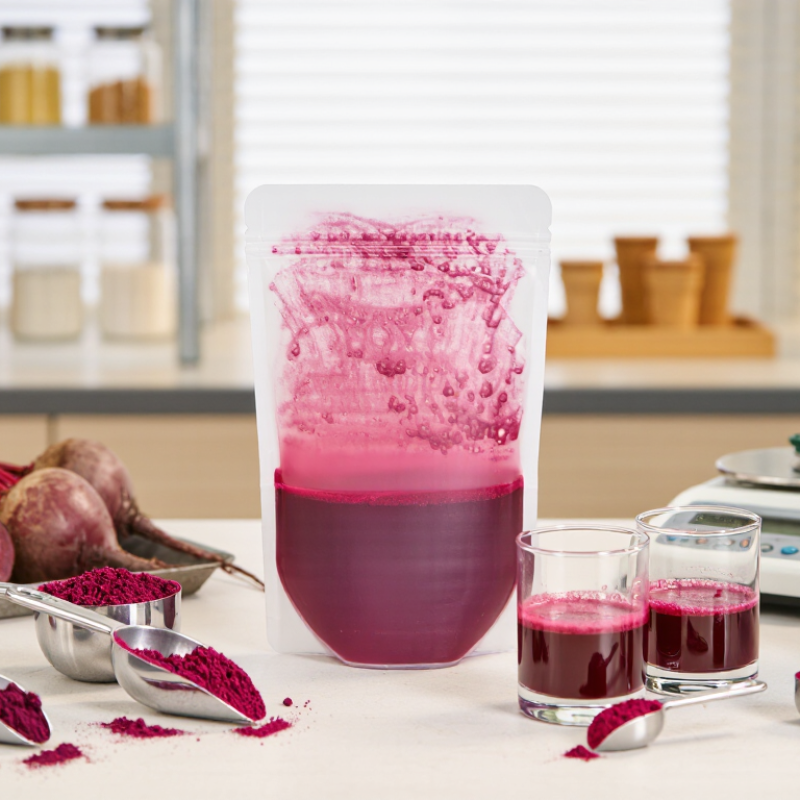
Beet root juice powder is made by concentrating beet juice and removing water. Its composition may include natural sugars, pigments, minerals, dietary compounds, and nitrate. However, it is not identical to ordinary beetroot powder, which is often made from the whole dried root. This difference affects taste, solubility, color, and nitrate concentration.
Nitrate content can vary between harvests, processing methods, and suppliers. Industry definitions are not always consistent. Some sellers describe a product by its source, while others highlight a standardized nitrate level. Buyers should request a current certificate of analysis showing nitrate results, moisture, microbiological limits, and testing methods. Bulk purchasing may improve production consistency and reduce packaging costs, but only when the material remains stable during storage. A large order is not automatically a smart order.
Tips: Compare nitrate values on a dry-weight basis. Check whether testing covers the actual batch. Store the powder in a sealed, dry container away from heat and light. Ask how the powder dissolves in cold water. Small trials help.
From practical quality checks, color alone is unreliable. A deep red powder may reflect betalain pigments, not higher nitrate. I would also avoid treating a supplier’s “high nitrate” wording as a technical definition. Documentation matters more than attractive claims. Nitrate data should be interpreted carefully, especially when the powder will be used in formulated foods or beverages.
Bulk Pricing Economics: Cost per Serving, MOQ, and Supply-Chain Savings
Why Buy Beet Root Juice Powder in Bulk?
Bulk Pricing Economics: Cost per Serving, MOQ, and Supply-Chain Savings
Buying beet root juice powder in bulk can reduce the cost per serving. The real savings depend on more than the invoice price. Compare the powder cost, packaging, freight, customs, testing, and warehouse handling. A supplier may offer a lower kilogram price, but extra shipping can erase the advantage. Calculate the landed cost before approving a purchase.
Minimum order quantity, or MOQ, also affects cash flow. A larger MOQ may unlock better pricing and fewer deliveries. However, excess inventory can absorb storage space and expire before use. Check the batch date, shelf life, moisture protection, and recommended storage conditions. Ask for a certificate of analysis, microbial results, and clear lot traceability. These documents support consistent quality and responsible purchasing.
Tips: Divide the total landed cost by the confirmed number of servings. Request tiered quotes at three volumes. Test one production batch before committing to a large MOQ. Keep a small buffer, not a warehouse full of optimism. Supply-chain savings are useful only when demand forecasts are realistic. Mistakes happen when buyers focus on price and overlook handling losses, delayed shipments, or changing sales patterns.
Why Buy Beet Root Juice Powder in Bulk? - Bulk Pricing Economics: Cost per Serving, MOQ, and Supply-Chain Savings
The model below uses a 5 g serving size and shows how larger purchase quantities can reduce product, freight, and handling costs. Figures are planning estimates in USD and should be confirmed with a supplier before placing an order.
| Purchase Tier | MOQ | Order Quantity | Estimated Product Cost | Estimated Freight & Handling | Landed Cost | Approx. Servings | Landed Cost per Serving | Savings vs. 25 kg Tier |
| Trial / Small Batch | 1 kg | 1 kg | $24.00/kg | $18.00 | $42.00 | 200 | $0.210 | — |
| Micro Bulk | 5 kg | 5 kg | $20.00/kg | $28.00 | $128.00 | 1,000 | $0.128 | 39.0% |
| Small Wholesale | 10 kg | 10 kg | $17.00/kg | $38.00 | $208.00 | 2,000 | $0.104 | 50.5% |
| Standard Wholesale | 25 kg | 25 kg | $14.00/kg | $55.00 | $405.00 | 5,000 | $0.081 | — |
| Large Bulk | 100 kg | 100 kg | $12.00/kg | $120.00 | $1,320.00 | 20,000 | $0.066 | 18.5% |
| Pallet-Level Bulk | 500 kg | 500 kg | $10.50/kg | $420.00 | $5,670.00 | 100,000 | $0.057 | 29.6% |
Calculation assumptions: 1 kg of beet root juice powder provides approximately 200 servings at 5 g per serving. Landed cost equals product cost plus estimated freight and handling. Savings are calculated against the $0.081 landed cost per serving at the 25 kg standard-wholesale tier. Actual pricing may vary according to nitrate specification, organic certification, mesh size, moisture limits, packaging format, testing requirements, payment terms, shipping method, and delivery destination.
Nitrate Standardization and EFSA’s 3.7 mg/kg Body-Weight Reference
Why Buy Beet Root Juice Powder in Bulk?
Bulk purchasing can improve consistency, but only when nitrate content is carefully standardized. Beet root powders may vary between harvests, processing methods, and storage conditions. A red color does not prove a reliable nitrate level.
Look for independent laboratory testing and a clear certificate of analysis. It should state nitrate content per gram, test method, batch number, and production date. This detail helps calculate an accurate serving size. For example, a powder containing 50 mg of nitrate per gram differs greatly from one containing 20 mg. Small errors become significant in a large container.
EFSA’s reference value for nitrate is 3.7 mg per kilogram of body weight per day. This is an acceptable daily intake, not a guaranteed performance target. A 70-kilogram adult would reach about 259 mg of nitrate from all dietary sources combined. Beet powder is only one source. Vegetables, drinking water, and other foods may contribute more. Professional buyers should assess the full intake rather than rely on a scoop alone.
Storage also matters. Keep opened powder sealed, dry, and away from heat. Moisture can cause clumping and may affect quality. Bulk stock is convenient, yet it can sit for months. I would question any supplier offering only a bright color claim. I would also recheck testing after formulation changes, because “standardized” does not always mean perfectly uniform.
Why Buy Beetroot Juice Powder in Bulk?
Nitrate Standardization and EFSA’s 3.7 mg/kg Body-Weight Reference
The chart shows the daily nitrate reference amount calculated from EFSA’s reference value of 3.7 mg nitrate per kilogram of body weight per day. Values are calculated as body weight × 3.7 mg/kg. Bulk purchasing can support consistent formulation and batch testing, but the actual nitrate concentration of beetroot juice powder should always be verified by a certificate of analysis.
Quality Control: COAs, Heavy-Metal Limits, Microbiology, and ISO 22000
Buying beet root juice powder in bulk can reduce packaging waste and stabilize production costs. Quality, however, must scale with volume. A single weak lot can affect thousands of servings.
A reliable supplier should provide a lot-specific Certificate of Analysis (COA). It should show the batch number, test date, methods, laboratory identity, and numerical results. Check heavy metals separately, including lead, cadmium, arsenic, and mercury. The FAO/WHO Codex framework applies contaminant limits by food category and market, not one universal number. WHO also states that no safe level of lead exposure has been identified. Limits should match the destination market.
Microbiology needs equal attention. Request results for total aerobic count, yeast and mold, Escherichia coli, and Salmonella. Testing should use recognized methods, such as validated AOAC or pharmacopeial procedures. ISO 22000 certification adds value because it supports hazard analysis, traceability, and corrective actions. The ISO Survey 2021 recorded 45,459 ISO 22000 certificates worldwide. Yet certification does not prove that every batch is perfect. It is a management framework, not a substitute for lot testing.
Ask for recent reports, not generic templates. Compare COA results with your written specifications. Review sampling plans, storage conditions, and retest policies. Moisture is easy to overlook. It can quietly increase microbial risk during long storage. I would also verify the laboratory’s accreditation. Supplier paperwork can look convincing, but independent confirmation is sometimes worth the extra cost.
Bulk Purchasing Compliance Under FDA 21 CFR Part 111 cGMP Standards
Why Buy Beet Root Juice Powder in Bulk?
Bulk beet root juice powder can support consistent production, stable inventory, and more predictable purchasing costs. However, volume alone does not demonstrate quality. For products entering the United States dietary supplement market, buyers should assess suppliers against FDA 21 CFR Part 111 cGMP requirements.
The supplier should maintain written specifications for identity, purity, strength, composition, and contaminant limits. Beet root powder may require attention to moisture, microbial contamination, heavy metals, pesticides, and color consistency. Testing should use scientifically valid methods, with results linked to the specific lot. A certificate of analysis helps, but it is not enough.
Look for documented master manufacturing records and executed batch production records. Packaging, labeling, storage, and distribution controls also matter. The powder should arrive in sealed, food-grade containers with lot numbers, production dates, and suitable storage instructions. Temperature and humidity records can reveal problems during transport.
Ask how deviations, complaints, recalls, and corrective actions are handled. Request supplier qualification records when appropriate. Audit access may provide stronger evidence than polished documents. Still, even a careful review has limits. Paperwork can be complete while sampling remains weak. Buyers should compare laboratory results with independent testing for higher-risk lots. A practical bulk program also defines acceptance criteria before purchase, not after a shipment fails. Small details matter.