What is an AC DC Power Supply and How Does it Work?
An Ac Dc Power Supply is essential for many electronic devices. These devices often require different types of power to operate efficiently. Understanding how an AC DC power supply works can help users choose the right one.
AC DC power supplies convert alternating current (AC) to direct current (DC). This conversion allows devices like laptops, smartphones, and LED lights to function properly. Many people use these power supplies daily, yet few know their inner workings.
The importance of knowing the mechanics behind an AC DC power supply is clear. Users may overlook issues like voltage, current rating, and efficiency. A poorly chosen power supply can lead to device malfunction. The complexity of this topic invites further exploration.
What Is an AC DC Power Supply?
An AC DC power supply is a device that converts alternating current (AC) into direct current (DC). This conversion is essential for many electronic devices. Most gadgets we use need DC power to function effectively. Without this conversion, the devices could not operate properly.
AC power comes from the wall outlet. It oscillates, switching directions periodically. In contrast, DC power flows steadily in one direction. Devices like smartphones and laptops rely heavily on DC power supplies. They require stable voltage for efficient operation.
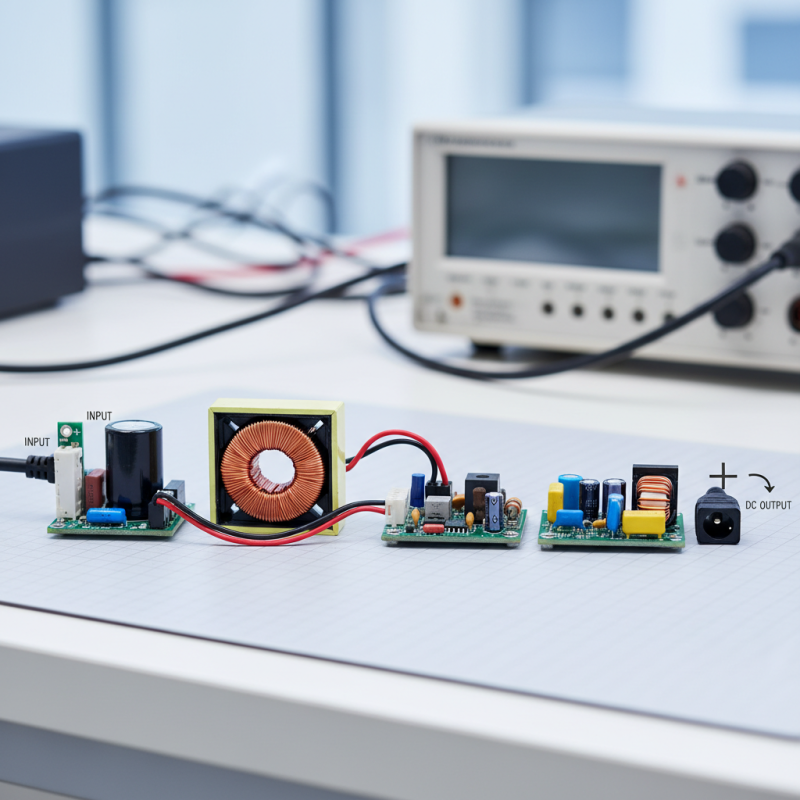
The working mechanism of an AC DC power supply involves several key components. Transformers adjust the voltage levels. Rectifiers then convert AC to DC. Filtering capacitors smooth the output, ensuring consistent power flow. However, understanding these intricacies can be challenging. Sometimes, users face issues like overheating or voltage fluctuations, which may cause device malfunctions. Recognizing these problems is crucial for troubleshooting.
The Basic Principles of AC and DC Power
AC and DC power are fundamental concepts in electrical engineering. Alternating Current (AC) fluctuates over time, while Direct Current (DC) flows steadily in one direction. In household wiring, AC is predominant. It allows for efficient long-distance transmission with minimal energy loss. According to the U.S. Energy Information Administration, about 75% of American homes use AC power. Its ability to transform voltages easily makes it versatile for various applications.
On the other hand, DC power is crucial for electronic devices. Many appliances, such as laptops and smartphones, require DC for operation. Reports show that the global market for DC power supplies is projected to grow significantly, driven by the demand for energy-efficient systems. However, converting AC to DC can lead to inefficiencies. Some converters waste energy in the process. The challenge remains that not all devices are compatible with both power types. As technology advances, finding a balance between AC and DC remains essential for future developments.
Components of AC DC Power Supply
An AC DC power supply transforms alternating current (AC) to direct current (DC). This conversion is essential for many electronic devices. The main components include transformers, rectifiers, and filters. Each plays a crucial role in ensuring a stable output.
The transformer steps down the AC voltage to a suitable level. It uses electromagnetic induction, which might seem simple. However, poor design can lead to energy losses. Then, rectifiers convert AC into DC. This process often uses diodes. They can be efficient, but not all designs optimize power flow.
Filters smooth out the DC signal. They reduce voltage ripples, which is vital for sensitive electronics. The effectiveness of filters can vary. A poorly designed filter might not eliminate enough noise. Such imperfections in power supply design can affect device performance. Understanding these components can lead to better applications and improvements.
How AC DC Power Supply Converts Energy
An AC DC power supply serves a critical function in many electronic devices. It converts alternating current (AC) into direct current (DC). This process is essential for powering devices that require a steady voltage. The conversion begins with a transformer, which adjusts the voltage level. Then, a rectifier transforms AC into DC by allowing current to flow in one direction. This process is vital for ensuring device efficiency.
The smoothing stage is crucial after rectification. Capacitors are used to filter out fluctuations in the DC output. This allows the power supply to deliver a stable voltage. However, issues can arise if the filtering is inadequate. Devices may experience performance problems under fluctuating conditions. A poorly designed power supply can lead to overheating or even failure.
Many users overlook the importance of these power supplies. They expect seamless operation without understanding the underlying technology. When devices malfunction, it often traces back to power supply issues. Awareness of this can lead to better device maintenance. People may even find that replacing an old power supply solves multiple problems. Understanding how AC DC power supplies work can improve user experience significantly.
Applications of AC DC Power Supply in Everyday Use
The AC DC power supply is vital in modern electronics. From smartphones to laptops, it converts alternating current (AC) to direct current (DC). This conversion is not just a technicality; it ensures devices receive stable power. Many appliances rely on this technology, which is often taken for granted.
According to industry reports, the global AC DC power supply market is expected to grow significantly. By 2025, it could reach over $25 billion. This growth reflects our increasing reliance on various devices. For example, in homes, LED lighting often employs AC DC supplies for energy efficiency. In industrial applications, these supplies drive automation and robotics, enhancing productivity.
However, efficiency remains a challenge. Many AC DC power supplies waste energy during conversion. Reports reveal that up to 15% of energy can be lost in some systems. This inefficiency prompts manufacturers to innovate for better designs. Despite advancements, achieving optimal performance and minimizing waste is ongoing work. Balancing power needs with energy conservation will continue to be a pressing issue.